

Because He First Forgave Us
"Then Peter came to Jesus and asked, 'Lord, how many times shall I forgive my brother or sister who sins against me? Up to seven times?' Jesus answered, 'I tell you, not seven times, but seventy-seven times.'" — Matthew 18:21-22
If “Forgiveness Is a Choice, Not a Feeling” left you sitting with the question of whether you want to forgive, this post is going to take you somewhere a little deeper and a little more uncomfortable.
Because once you've wrestled with the willingness, the next questions that surfaces are usually: but why? Why does God ask this of me? Why is forgiveness something He requires and not just something He suggests?
Those are fair questions. And Jesus has a direct answer.
But I want to warn you, His answer isn't the comfortable one. It wasn't for me anyway. It was the convicting one. And conviction, I've learned, is often just love being honest with you.

The Jonah Moment
Can I tell you something that took courage for me to admit?
When I first started to understand that God was asking me to forgive because He forgives, that His own grace toward me was the model and the motivation, my first internal response wasn't gratitude.
It was resistance.
I felt like Jonah.
If you know the story, Jonah was called by God to go to Nineveh — a city full of people who had done real, documented, undeniable wrong. And Jonah's response was to go in the complete opposite direction. Not because he was afraid. But because he didn't think they deserved God's grace. He knew God would forgive them if they repented and he didn't want that for them. He wanted consequences. He wanted accountability. He wanted justice.
And I understood that feeling in a way that convicted me deeply.
Because when someone has hurt you, when the damage they caused is real and the people you love most bore the weight of their choices, there is a part of you that doesn't want grace to be available to them. You want what they did to cost them something. You want the record to stand.
And then Jesus steps in and say, “I forgave you too. I died for you too. Now you get to do that.”
And your honest human response is, “God, You are asking too much.”
But Didn't He Though?
Here's where I had to get really honest with myself.
Is it unfair? Is God asking too much?
I sat with that question for a long time. And what I kept coming back to was this, we are the reason Jesus died on the cross. Not in spite of us. Because of us. Because of our sin, our choices, our rebellion, our falling short over and over and over again across the entire span of human history from Genesis to right now.

And He did it anyway.
So when I felt that resistance rising up, when I felt like the person who hurt me didn't deserve grace, I had to ask myself a harder question. Did I deserve it? Did any of us?
And the honest, humbling, gut-level answer is no.
This is where I think so many of us read the Bible in what I can only describe as a Disney mindset. We read it as if we are the hero of the story. The good guy. The one who deserves the happy ending. And in that reading, grace feels like something we've earned and forgiveness feels like something we get to decide who is worthy of.
But when you read Scripture honestly — when you sit in the full weight of what it says about human nature and sin and our relationship with God — you realize something that is both humbling and transformative.
We were not the good guy. We became God's enemy through our own desires and choices. Every single one of us. And God loved us anyway. Chased us anyway. Sent Jesus anyway.
That doesn't make the pain of what was done to you smaller. But it does make the ground level. It puts you and the person who hurt you standing in the same place before a God who chose to love and forgive you both.
And from that place, that leveled, humbled, honest place, forgiveness starts to look less like something God is asking too much of you. It becomes more like something He is inviting you into because He knows what it costs and He paid it Himself.
Why Jesus Says Forgive — The Real Answer
So why does Jesus ask us to forgive? Let's go straight to Scripture.
In Matthew 18, Peter comes to Jesus with what he thinks is a generous question. He asks, “how many times do I have to forgive someone who wrongs me? Seven times?” And Jesus answers, “not seven times. Seven times Seventy seven times.”
Which really means, stop counting.
And then Jesus tells a parable about a servant who owed an insurmountable debt to a king, a debt he could never repay no matter how long he lived or how hard he worked. And the king, moved by compassion, forgave the entire debt. Cancelled it completely. Wiped the record clean.
That same servant then went out and found someone who owed him a small amount — nothing compared to what he had just been forgiven — and refused to extend the same grace. He had the man thrown into prison.
When the king heard what happened he was grieved. And he said something that I think about often, “shouldn't you have had mercy on your fellow servant just as I had on you?”
That's the answer. That's why Jesus asks us to forgive.
Not because what was done to you wasn't wrong. Not because the person who hurt you deserves a pass. But because you have been on the receiving end of a forgiveness so vast, so unearned, so costly to the One who gave it — that withholding it from someone else becomes its own kind of contradiction.
Scripture puts it plainly, freely you receive, freely you give. (Matthew 10:5-8)
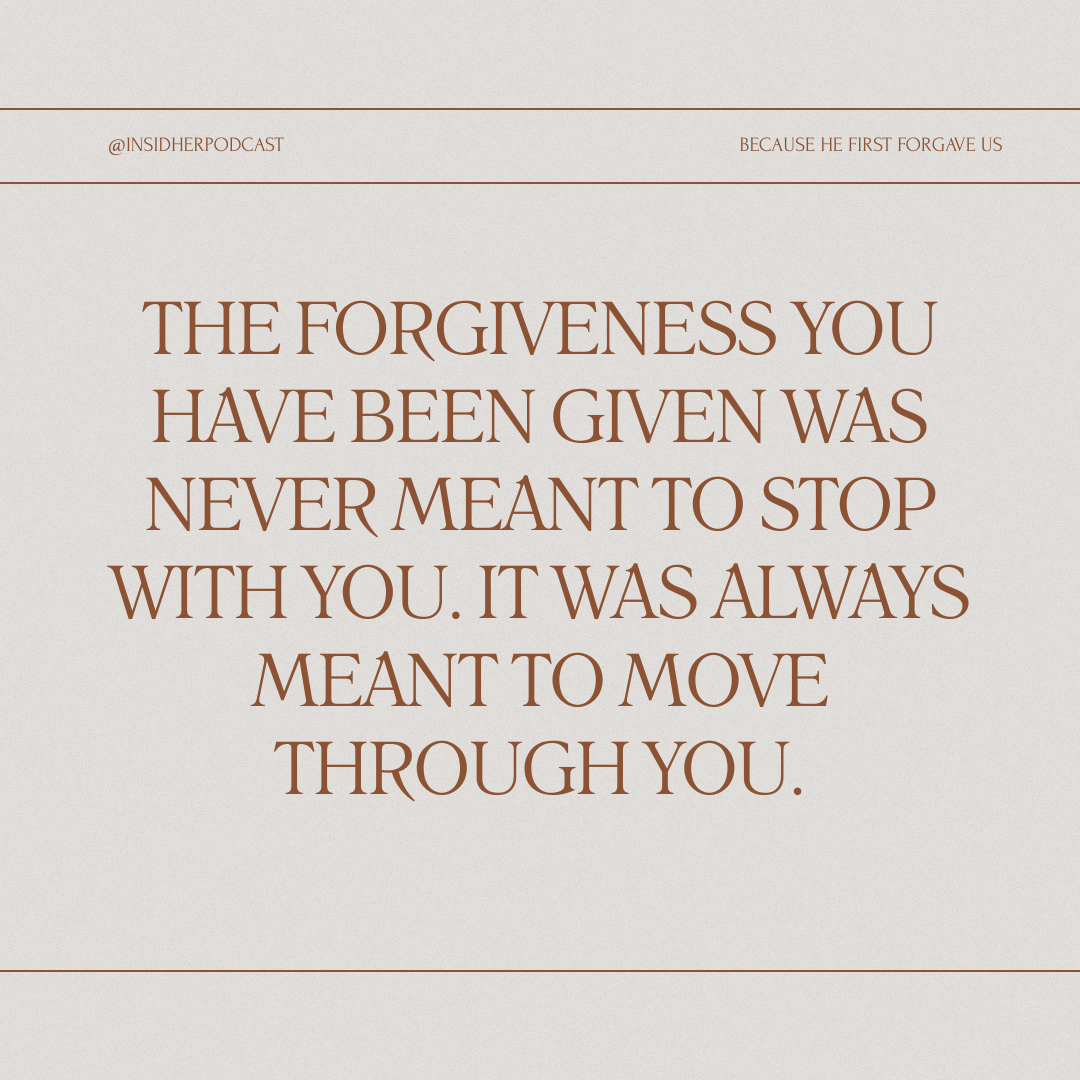
The forgiveness you've been given is not meant to stop with you. It was always meant to move through you.
The Conviction That Changes Everything
What moved me from resistance to willingness wasn't guilt. I want to be clear about that. God doesn't shame us into forgiveness. He doesn't hold our sins over our heads to manipulate us into extending grace to others.
What moved me was conviction. And there's a difference.
Guilt says, “you're a bad person for not forgiving.” Conviction says, “look how much you've been given. Look how loved you are. Don't you want to live from that place?”
When I truly sat in the reality of what Jesus did on the cross — not as a theological concept but as something personal and specific and costly — I felt convicted of how much I thought I deserved grace compared to the person who hurt me. I had been placing myself above them in a way that wasn't honest about who I am before God.
We are all flawed. We all fall short. Every single person who has ever hurt you has also been hurt by someone else. Every person who has wounded you is also a person Jesus died for.
That doesn't excuse what they did. It does change how you see them.
And when you ask God to help you see them the way He sees them — truly ask, with an open and willing heart — something begins to shift. You start to move from the hurt to something bigger. From the wound to the love that is larger than the wound.
That's not something you can manufacture on your own. I couldn't. But it's something God will do in you when you give Him the willingness to work with.
What This Means For You
Friend, I want to close with this.
If you read this post and felt convicted, good. That conviction is not condemnation. It's an invitation. It's God saying I have so much more for you on the other side of this than you can currently see.
If you read this and still feel like God is asking too much, that's okay too. Stay honest with Him about that. Tell Him exactly where you are. He can handle it. He handled Jonah after all.
And if you're sitting somewhere in between, willing but not quite there yet, convicted but not sure what to do with it, then I want to leave you with this prayer:
"Lord, I don't fully understand why You're asking this of me. But I know what You did for me. Help me to see what You see. Help me to receive Your grace deeply enough that I have something real to give. I am willing to be made willing. Meet me here."
That prayer, willing to be made willing, is enough to start with. It's enough for God to work with. And He will.
Until next time, Abi 🤎
Journal Prompt: Think about a time you received grace you did not earn or deserve. Maybe from God, maybe from another person. What did that feel like? Now think about someone you are struggling to forgive. When you place yourself and that person on the same level ground before God, what shifts, even slightly, in how you see them? Write an honest prayer, even if it is just a few sentences, telling God exactly where you are. You do not have to be ready. You just have to be willing to be made willing.