

The Anatomy of an Apology: What We Forget When We're Busy Protecting Ourselves
There is a quiet, heavy cost to loving people well.
We live in a world that is deeply obsessed with self-preservation. Protect your peace. Cut off what doesn't serve you. Guard your space. Honor your truth. And look, learning to guard your heart is necessary, especially for those of us who spent years shrinking ourselves just to keep everyone else comfortable. I am not dismissing that work. That work saved me.
But somewhere in the rush to protect ourselves, something quietly got lost. We stopped knowing how to repair.
We want the warmth of deep, chosen-family love. We want the kind of relationships that anchor you when the world feels unsteady. But we want them to stay smooth. Effortless. Comfortable. And the moment conflict enters the room, we reach for our boundaries like a shield and call it growth.
True community does not work that way. It never has.
To walk closely with another human being means that at some point, despite your best intentions, you will get it wrong. You will miss something. You will say the wrong thing at the wrong time. You will cause pain you never meant to cause. And when that happens, when someone who loves you gathers the courage to come to you and say "that hurt," you will be standing at one of the most important crossroads in any relationship.
Do you protect your ego? Or do you protect the heart standing in front of you?
The Moment That Changed How I See Apologies
I was thirteen years old when I first understood what a real apology actually is.
I came home from school carrying something heavy. I had been dealing with being bullied, and I walked through the door full of frustration and hurt that had nowhere to go. Someone who has always been one of the most foundational people in my life, my anchor of love, safety, and security, was in the middle of something and asked me to handle a task right away. And I just snapped.
I looked at her and said something I had never said before. You don't even care about me. You didn't even ask how my day was going.
She was caught off guard at first. I think the sheer unexpectedness of it made her laugh a little, which only made me feel more invisible. But then she actually looked at me. She saw that I was really hurting. And she stopped.
She apologized. Genuinely, fully, without making it about herself.
I am now in my thirties. From that day to this one, she has never missed a moment to ask me how I am doing and how my day is going. Not once.
That is what a real apology does. It does not just address the moment. It changes the behavior. It says I see you, I heard you, and you matter enough to me to actually shift. That was the first time I watched someone take full ownership of their impact, validate my feelings without making me fight for it, and then follow through with something different. I was thirteen years old and I did not have language for it yet. But something in me recognized it as the most powerful thing I had ever witnessed in a relationship.
I have been chasing that standard ever since.
What a Real Apology Actually Is
Because here is the thing. Most of us were never taught what an apology actually is. We were taught to say sorry. We were not taught what sorry means or what it requires of us.
A genuine apology is not a transaction to end the discomfort of conflict. It is not a magic phrase that makes things go back to normal. It is not a legal defense of your intentions.
A real apology is never:
"I'm sorry you feel that way." That is not an apology. That is a subtle way of placing the problem entirely on the other person's sensitivity while keeping your hands clean.
"Well, my intention was..." That sentence centers you. It asks a hurting person to hold space for your motives before you have held space for their reality.
"Oops, my bad." That minimizes someone's vulnerability because sitting in the weight of what happened is too uncomfortable for you.
A true apology requires you to actually step into the other person's experience. To hear not just what they said but what they felt. To reflect their pain back to them in a way that says I understand the specific shape of what my actions created, and because I value you, that matters more to me than being right.
That is not weakness. That is one of the most courageous things one person can offer another.
The Real Question Underneath Every Apology
Before we go any further, I want to ask you something. And I want you to sit with it honestly before you keep reading.
Do you actually love this person the way you say you do?
Not in the general, I wish them well kind of way. Not in the we have history and I do not want things to be weird kind of way. I mean genuinely, actively, choose-them-when-it-costs-something love.
Because here is what I have come to understand. An apology is not really about the words. It is not about getting the phrasing right or following the correct steps or demonstrating that you have done your emotional work. At its core, an apology is a love test. It is the moment where everything you have said about how much you care about someone gets to prove itself true.
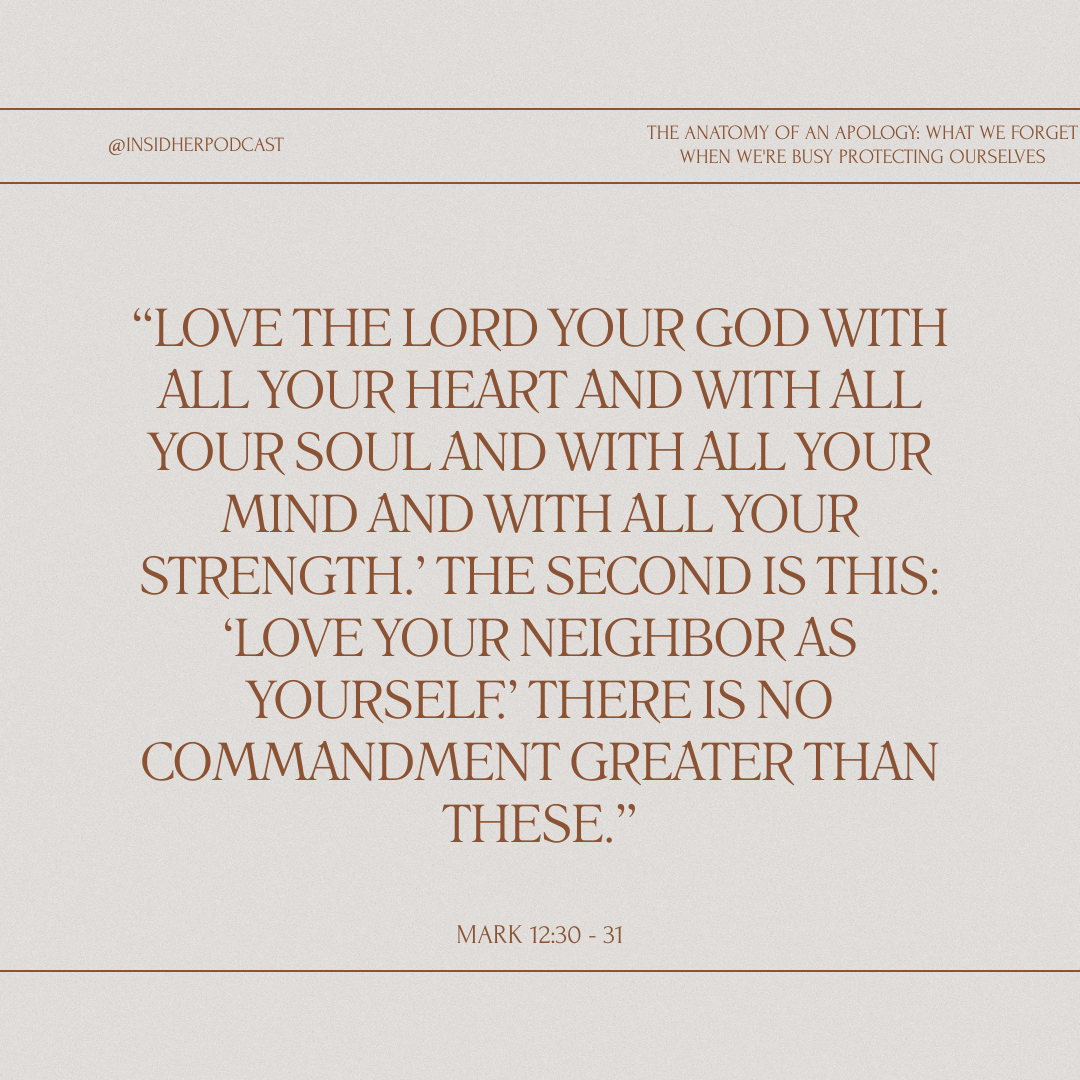
Jesus said it plainly in Mark 12. Love your neighbor as yourself. Not when it is convenient. Not when they have earned it. Not when the dynamic is balanced and reciprocal and comfortable. As yourself. With the same instinct you have to protect your own heart, your own reputation, your own peace. That same instinct turned outward toward the person standing in front of you.
So when someone you love comes to you hurting, the question is not really "did I do something wrong." The question is "do I love this person enough to set myself aside right now and find out?"
That question changes everything. Because when love is genuinely at the center, the ego does not disappear, but it stops being the loudest voice in the room. You stop asking whether you are being taken advantage of. You stop calculating whether this apology makes you look weak. You start asking something simpler and truer.
What does this person need from me right now? And am I willing to give it?
That is where a real apology begins. Not in technique. In love.
The Trap Nobody Warns You About
Here is something that does not get talked about enough in healing spaces.
When you wake up to people-pleasing patterns, one of the first things you start to unlearn is over-apologizing. You stop saying sorry as a reflex just to keep the peace. You stop shrinking yourself to make other people comfortable. That is healthy and necessary work.
But there is a trap waiting on the other side of that unlearning.
In our effort to stop apologizing for things that are not our fault, we can accidentally stop apologizing for things that are. We start confusing genuine accountability with people-pleasing. We tell ourselves we are setting a boundary when really we are just protecting our ego. And we use the language of healing to justify shutting down when someone we love brings us a real wound.
I have watched this destroy relationships that did not have to end. Looking back at friendships and dynamics I am no longer part of, a real apology would have saved several of them. Not a performative one. Not one wrapped in defensiveness and qualifiers. A genuine, humble, ego-setting-aside apology. And when that never came, or when things escalated to a place where it was too late, those relationships did not survive.
The cost of community is inconvenience. And sometimes that inconvenience is being willing to eat your ego so that someone you love does not have to eat their pain alone.
When You Do Not Get It Right In the Moment
None of us get this perfectly. I want to say that clearly because I do not want anyone reading this to walk away feeling like they are failing at relationships because conflict is hard for them.
It is hard for everyone. Especially when you have a history of being taken advantage of. When someone brings you a hurt, your nervous system does not always know the difference between someone holding you accountable and someone trying to control you. That confusion is real and it deserves grace.
That is why the pause matters so much.
When someone comes to you with something that hurt them, you do not have to have the perfect response in that moment. What you do have to do is stay present enough to honor that they came to you at all. It takes courage to tell someone they hurt you. It takes even more to stay soft while you do it.
If you need space to process before you respond well, you can say that. Something as simple as: “I hear you and I can see that you are hurting. Because I care about you and I do not want to give you a reactive response, can I take some time to sit with this and come back to this conversation?” That kind of honesty, offered with warmth, is not avoidance. That is maturity.
The question to ask yourself in that pause is simple. Do I actually value this person the way I say I do? Because if the answer is yes, the apology becomes a lot less about pride and a lot more about love.
When the Apology Never Comes
And then there is the other side of this. The side where you are the one who came with the wound, and the person across from you chose their ego over your heart.
I know what that feels like. The need to explain yourself more clearly, to reopen the conversation, to make them understand what they did. The hope that if you just say it the right way, they will finally see it.
But a non-apology is still an answer. When someone shows you that their narrative matters more to them than your pain, that is information. You do not have to fight to be believed by someone who has already decided to protect themselves at your expense.
You take that heartbreaking piece of information, hand it to God, and adjust accordingly. Walking away quietly is not bitterness. Sometimes it is the most self-respecting thing you can do.
What I Know For Sure

Paul said it plainly. If I have all these things, if I speak in tongues, if I move mountains, if I give everything I have, but I do not have love, I have nothing (1 Corinthians 13: ). And I think about that when I think about apologies. Because at the end of the day, an apology is not really about the words. It is not about the technique or getting the phrasing exactly right. It is about one question.
Can I choose love right now?
Can I put myself to the side, in this moment, in the middle of my confusion and my pain and my ego, and choose love for this person?
That is what Jesus modeled. Not from a place of ease or comfort. From a place of full surrender. And that is what He asks of us in our relationships too. Not perfection. Just love, chosen deliberately, even when it costs something.
I will never regret offering a sincere, humble apology and discovering later that the other person was not ready to receive it well. My heart stays clean before God. I chose love over pride and I can live with that.
What I could not live with is withholding a genuine apology from someone who needed me to show up for them, simply because I was too guarded or too confused to offer it.
Healing was never meant to make us hard. It was meant to make us wise. Wise enough to know when to lay the armor down. Wise enough to know when to hold our ground. And wise enough to know that the people worth fighting for are worth the humility it takes to say I got that wrong, and I am sorry.
—Abigail 🤎
Journal Prompt: Think about a relationship in your life where a real apology, given or received, changed something. What did it make possible? And is there a conversation you have been putting off that might need one now?